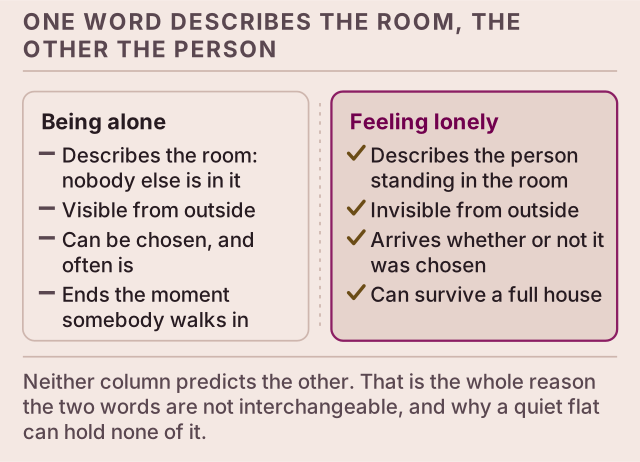
Lonely vs alone is the difference between a fact and a feeling that keeps getting reported as one word. Being alone can be established from the doorway: one person, one room, nobody else. Loneliness cannot be established from the doorway at all, because it is not about the headcount. It is a distance between the contact a week actually held and the contact that week wanted, and the person in the room is the only one who can say how wide it is.
Solitude refers to time by yourself while it is still chosen — the same empty flat, entered on purpose, with the door shut for a reason. Nothing about the room changes when the choosing stops. What changes is what the quiet is doing: waiting for you, or happening to you. That is why two evenings that photograph identically can be described so differently by the person who spent them.
What is loneliness actually made of?
Loneliness is made of a gap, not a headcount. Two marks sit some distance apart: the contact a life currently holds, and the contact it was expecting to hold. The gap can open because the first mark moved — a friend leaves, a marriage ends, a job that came with people stops — or because the second one moved, after an illness, a birthday, a bad year. Nothing dramatic has to have happened for the distance to be there.
This is the part that makes the word so slippery in ordinary use. Counting is no use as a measure of it. Consider two Saturdays with exactly the same shape: one text message, one shop, one evening at home. On the first, nothing is missing. On the second, everything is. The week did not change; the second mark did.
Are there different kinds of loneliness?
There are different shortfalls, and they do not answer to the same things. Emotional loneliness means one particular closeness is missing, and general company does not stand in for it — the room fills up and the gap stays exactly where it was. Social loneliness is the absence of a group to belong to: known in several places, expected in none of them, with nothing on the calendar that would register an absence.
The idea underneath the first one is not new, and it is not this site’s. It comes out of attachment theory, set out in Bowlby’s Attachment and Loss (Bowlby, 1969): the absence of one particular person is not interchangeable with the presence of people in general. That is a claim about how attachment works, not a claim about loneliness rates, and it is quoted here for exactly as far as it goes.
Naming which shortfall is in the room is worth doing, because it changes what would help:
- If any company at all would ease it, the shortfall is about people in general, and a room with people in it is a real answer.
- If only one particular person would ease it, a room with people in it is not an answer, and arranging more of them can make the evening louder rather than easier.
- If neither would touch it, the state is doing something else, and no arrangement is the missing piece.
None of that sorts a reader into a type. It sorts the evening.
Why does the same evening feel different on different days?
Because the second mark moves and the room does not. A flat on a Tuesday after a full day of talking is not the same flat on a Sunday after a silent weekend, even though nothing in it has been rearranged. The furniture is a constant. What varies is what the day was covering, and how much covering it did.
For example, an evening that follows a crowded, sociable afternoon can land harder than an evening that follows a quiet one. The drop is what registers, not the level. That is an ordinary feature of the state rather than a sign that something is going wrong.
Can somebody get used to being alone?
People describe getting used to the arrangement rather than getting used to the feeling, and the two are worth keeping apart. The practical side of living by yourself does settle — the routines stop needing decisions, the quiet stops announcing itself at the door. Whether the gap narrows is a separate question with a separate answer, and it is not one a page can answer for a particular reader.
There is also a version that looks like having settled and is not. Adult attachment research describes two broad directions people move in when the closeness they want is not available: pressing harder for it, or shutting the need down (Mikulincer and Shaver, 2012). The second one is quiet from outside. Imagine somebody who has stopped replying to invitations and describes themselves as having become a private person — the description may be accurate, and it may be the need switched off. Nothing on this page can tell those two apart, and it does not try.
Where does this section stop?
It stops at the point where description turns into assessment. This section can set out what the state is, what it is made of, and what people report about living inside it. It cannot say which version a reader has, how long theirs will run, or what would close it — those are not things a page knows.
It also stops short of the border with something clinical. Loneliness and depression overlap, and telling them apart is clinical work rather than reading work. If the state has stopped lifting at all, or has turned into hopelessness, or has moved into sleep, eating and the ability to work, that belongs with a doctor or a therapist rather than with a website.