
Support groups for loneliness are scheduled peer meetings whose stated subject is the thing nobody raises anywhere else. People look them up once the state has a name and the next question is practical: what is that room actually like, and who is in it. This page describes the formats, what a meeting consists of, what is absent from it, how people find one, and what can be asked before walking in. It names no organisation and links to no service, on purpose.
What is a support group for loneliness?
A peer group is a meeting where the people in the circle are not staff and nobody is a patient. Everyone is there for the same reason, which removes the explanation that makes the subject hard to bring up elsewhere. Attendance is the entire qualification for being there.
That is the difference from a hobby club, a class or a walking group — for example a weekly choir or a Tuesday-night language class, all of which put people in a room together while the reason stays unspoken. In a support group the reason is the agenda. Nothing is diagnosed, nothing is prescribed, and nobody’s attendance is recorded as progress.
Groups are peer-based: the people in the circle are not staff. A facilitator may be a volunteer who has been through the same thing, someone trained by the organisation that hosts the meeting, or a member whose turn it is. The role is to open, keep time and hold the ground rules, not to assess anyone.
If the underlying question is whether the state itself is what it looks like, that is a separate one, and the hub on being lonely versus being alone works through it. A group does not settle that question either.
What formats do loneliness support groups come in?
A format is the combination of where a meeting happens and who it is drawn around, and it is the thing that varies most between groups. In-person meetings sit in a room, at a fixed hour, in a venue that has to be travelled to. Online meetings run by video or by text. Themed groups narrow the circle to a shared circumstance. Open groups take anyone who arrives.
In person. A room, chairs in a circle, a start and end time, and a venue that is a library, a community centre, a church hall, a health centre back room or a café outside opening hours. Travelling to it is part of the arrangement: it puts a departure in the day.
Online. Video calls, moderated forums, and text or chat rooms that keep a meeting time. These remove travel, which matters where mobility, cost or geography rule out the first format. They also remove the doorway conversation, the tea, and the walk home, which is where contact in a physical group also happens.
Themed by circumstance. Groups that draw the circle around a situation rather than an age, such as people living alone, people who moved to a new town, carers, people who have retired, or people whose household recently changed size. The narrowing is what makes the talking shorter — less has to be explained from scratch.
Hosted by a community. Meetings attached to a congregation, a residents’ association, a library programme, a mental-health charity’s peer arm, a workplace network, or a health service’s community offer. The host shapes the tone more than the format does. A group inside a faith community carries that community’s language; a group run by a charity carries its house rules.
Other distinctions cut across these. Drop-in groups accept whoever turns up on the night; closed cohorts start together and keep the same membership for a run of sessions. Structured meetings work through a topic; open-floor meetings do not.
What actually happens at a support group meeting?
The shape is consistent: an opening, ground rules, people speaking in turn, and an ending at a fixed time. The facilitator says what the group is and is not, names confidentiality, and asks that people speak about themselves rather than advise each other. Then the floor goes round.
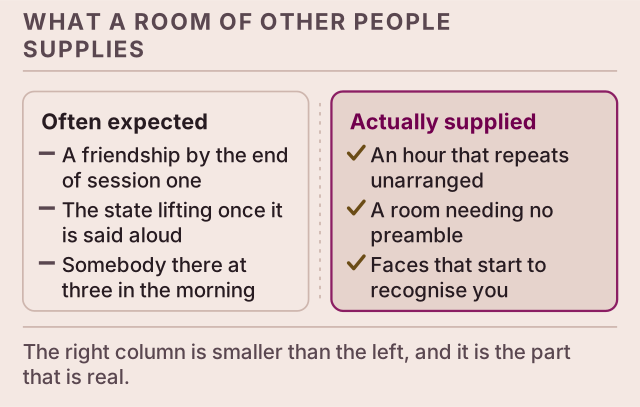
What people say is smaller than the subject makes it sound. A stretch of the week. A phone that did not ring. A weekend spent indoors that was fine until Sunday afternoon. The material is ordinary, which is the point: it is the register in which the subject can be spoken about without either performance or crisis.
Listening is the other half, and it is doing more work than it appears to. Hearing the same description in someone else’s voice separates the state from the person having it. That is not a cure and is not offered as one, but it changes what the state seems to be evidence of.
Groups that pair the talking with something else exist — a walk, a shared meal, a task. Side-by-side formats lower the intensity of a circle of faces and give people who freeze in a turn-taking round something to do with their hands.
Then it ends. A group has a clock, which is a feature: it means the meeting cannot become the whole evening, and it means nobody has to work out how to leave.
What is not there?
A support group does not diagnose, does not treat, and does not decide what is wrong with anyone. Nobody in the circle is qualified to say whether what a person is carrying is loneliness or something a clinician should be looking at, and a well-run group says so at the start.
It is not a friendship service either. People do exchange numbers, and a group can be where an acquaintance starts. That is a by-product, not the arrangement, and going in with it as the target sets up a disappointment the group was never structured to prevent. Building contact from scratch is its own mechanics, closer to what learning to be alone describes.
Where the ground rules exclude cross-talk, people do not answer each other’s turn with solutions. That can read as coldness on a first visit. It is there because advice handed to a stranger about a life described in outline lands badly, and because a room where everyone is fixing everyone stops being a place anyone can say anything in.
There is no obligation to return, no register, and no one who follows up if a person stops coming — unless the group says otherwise up front.
Is a support group the same as group therapy?
No, and the distinction is worth holding onto. Group therapy is treatment: it is run by a clinician, and it has an intake conversation before joining, a closed membership, a treatment aim, and a fee or a referral behind it. A support group is peer-run, open at the door, and has no clinical purpose at all.
The words get used loosely, including by groups themselves. A meeting advertised as therapeutic, healing or restorative is either group therapy under a softer name or a support group overclaiming. Asking directly — who runs this, and are they a clinician — resolves it in one question.
Neither format is the better one. They answer different questions, and a person can be in one, the other, both, or neither.

How do people find a support group for loneliness?
The routes people use are a general practice, community listings kept by a local authority, noticeboards inside libraries and community centres, venues that host meetings without running them, and helplines whose function is signposting rather than counselling.
Consider the general practice route first: staff there may know what runs locally, and that route filters out groups nobody can vouch for. Asking is a short conversation and does not commit anyone to anything clinical.
Online search surfaces a different mixture. Peer forums and moderated groups sit next to paid memberships, coaching funnels and communities that exist to sell something further down. The check is the same in each case: who runs this, what does it cost now and later, and what happens to what is said in the room.
Word of mouth is the remaining route, and it is the one that carries usable detail — what the group is actually like on a Tuesday, rather than what its listing says.
What is worth asking before a first visit?
Ask who runs it and what standing they have, whether it is drop-in or a fixed cohort, whether it costs anything at any stage, whether confidentiality is stated aloud at the start, whether speaking is expected of newcomers, and whether leaving part-way through is acceptable.
Who is in the room. Not names — the shape. Whether it is mixed in age and circumstance or drawn around one situation. A group whose members are all in a life stage far from yours can be a perfectly good meeting and still leave the visit feeling like a mismatch.
How the turn-taking works. Whether everyone speaks in order, whether the floor is open, and whether passing is a normal move. This is the question that changes how a first visit feels.
What happens outside the meeting. Whether there is a group chat, whether people stay afterwards, and whether contact between members is encouraged or discouraged. Groups differ sharply on this.
For online groups. Whether anything is recorded, whether cameras are required, and who can see the membership list.
None of these questions is rude, and a group that cannot answer them plainly has told you something.
What if the first visit does not land?
A visit samples one room on one evening, with whoever happened to be there. A group that did not fit is not evidence that the format does not work, and a group that fits perfectly is not a plan for the rest of the week either.
The state that brought someone to the search has a schedule of its own, and the hours it gets loudest are not the hours a meeting runs — what happens in those hours is covered in when loneliness hits. A weekly meeting sits inside a week; it does not replace it.
What this page does not do
This page describes a format. What sits outside it is deliberate.
- We do not name groups, charities or platforms
- No organisations, no apps, no links to services. We have not sat in these rooms and cannot vouch for any of them, and a recommendation we cannot stand behind in a health-adjacent subject is worse than no recommendation.
- We do not promise a group will help
- No claim about what attendance produces. What a meeting consists of can be described; what it does for a particular person cannot be, and pages that state it anyway are guessing.
- We do not call peer groups therapy
- A support group is not treatment and is not run by clinicians. Blurring them is how people end up expecting clinical care from a circle of chairs.
- We do not print figures
- No numbers about attendance, outcomes or how common any of this is. Nothing on this site has a figure behind it that traced back to a source we opened, so there are none here.
Where this page stops
This page can describe what support groups for loneliness are, how they are organised and what to ask before attending one. It cannot tell what any particular reader is living through, and it does not distinguish between loneliness and depression, which are different things. If this has been heavy for a long stretch, or is getting heavier, the next step is a conversation with a general practitioner or a therapist, or contact with a helpline in your country.