
What is emotional loneliness?
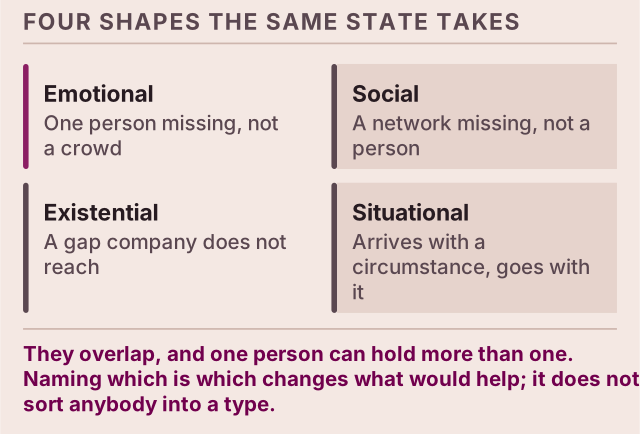
Emotional loneliness is the absence of one close attachment — a single person for whom the context of your life is already loaded, so nothing has to be explained from the beginning. It is a shortfall of depth, not of company. Consider someone with a busy week, a good team and regular plans: they can have it in full.
This is why the word “lonely” confuses people who look at their own calendar and decide they have no right to it. The calendar answers a different question. Emotional loneliness asks whether there is anyone who would notice a change in tone, and it is possible for the answer to be no while the diary is full.
It is also the kind that survives being talked out of. Advice to see more people lands badly here, not because the advice is unkind, but because it is addressed to a different shortfall entirely. The idea underneath that — that the absence of one particular person is not interchangeable with the presence of people in general — comes out of attachment theory, set out in Bowlby’s Attachment and Loss (Bowlby, 1969). It is quoted here for that much and no further: it is a claim about how attachment works, not a claim about how common any of this is.
What does emotional loneliness feel like?
From the inside it feels like having nobody to tell. For instance, something happens — a result, a scare, a small piece of luck — and there is a pause where the reflex to reach for someone used to be, and then the thing simply stays unsaid until it stops being current.
The second recognisable feature is editing. Conversation still happens, but a version of it goes out: the shortened account, the fine, the not much. That is not dishonesty. It is what people do when the relationship in front of them is not built to hold the longer version, and doing it repeatedly is tiring in a way that is hard to name at the end of the day.
The third is a specific kind of flatness after good social occasions. The evening went well. Nothing was wrong with anyone in the room. Walking home, the feeling is not disappointment in them; it is that the thing which was missing at the start of the evening is still missing, and now there is no plan left in the week to hide behind.

What is social loneliness?
Social loneliness is the absence of a group rather than of a person — no circle, no set of people with a shared reason to be in the same place, nobody who would notice an absence without being told about it. It is a shortfall of belonging, not of intimacy.
It shows up most clearly when the structures that used to produce a group stop running — such as a job ending, a household changing size, a move, or a marriage ending and the couple friends going with it. Nobody argued. The scaffolding was doing the work, and it came down.
Someone in a strong marriage can have social loneliness without emotional loneliness — one person holds everything, and there is no wider room to walk into. That combination is easy to miss in later life, which is why it is worth saying plainly: having one good attachment does not make a circle, and it was never supposed to.
| Kind | What is missing | What does not close it |
|---|---|---|
| Emotional loneliness | One close attachment where you are already known | More events, more acquaintances, a fuller calendar |
| Social loneliness | A group with a shared reason to meet | One very close relationship carrying everything |
| Existential loneliness | The sense of being reachable at all | Company, reassurance, or being told you are not alone |
What is existential loneliness?
Existential loneliness is the sense of being finally unreachable: that another person cannot fully enter your experience, no matter how close they are or how long they have known you. It is not produced by a shortage of people, and it is not repaired by adding any.
It surfaces at the edges of ordinary life — a quiet stretch, a change, an evening that was going fine. It can arrive in a room full of people who love you, which is exactly what makes it disorienting: the usual explanation, that there is nobody around, is visibly not true.
This page describes it without decorating it. There is a version of this subject written in borrowed profundity, and it helps nobody at midnight. The plain statement is enough: some part of a life does not transmit, this gets noticed sooner or later, and noticing it is not evidence that anything has gone wrong with them.
What does existential loneliness feel like?
It feels less like a lack than like a distance that will not close. The people are there. The conversation is real. And there is a simultaneous registration that the inside of your life is not being received, and could not be, and that this is not anyone’s failure.
Unlike emotional loneliness, it does not come with a name attached — there is no specific person whose absence explains it. Unlike social loneliness, it does not track the size of a circle. It arrives without a trigger and leaves without a resolution, and then returns without warning.
Because it has no obvious cause, people reach for one anyway and land on the nearest available explanation: the relationship, the town, the job. Sometimes that explanation is right. The feeling can also stay after the thing is changed, which is worth knowing before a large decision gets made in its name.
How do you deal with emotional loneliness?
Emotional loneliness responds to depth, not volume. The practical form of that is choosing one existing relationship and letting it carry something unedited — the longer version of the answer, said once, without a preamble apologising for it. Then again later, so it is not a single unusual evening.
That is slow, and it is the honest description rather than a cheerful one. It can fail with any given person. Someone may not have room, and that is information about their week rather than a verdict on the friendship. The method is repetition with the few people who do have room, not a search for one perfect confidant.
Social loneliness takes the opposite shape: regularity over intensity. A group forms out of being in the same place repeatedly for a reason that is not friendship — the same class, the same shift, the same evening. Nobody is being asked to be close. The circle is a by-product of showing up on a schedule.
Existential loneliness takes neither. There is no action that closes it, and treating it as a problem to be solved makes the evening worse. What people do with it is tolerate it, name it accurately while it is happening, and notice that it moves. That is not resignation; it is refusing to spend a night trying to fix something that is not broken.
The reason to tell the three apart is entirely practical. Aiming a social answer at an emotional shortfall produces a full week and no relief, which then gets read as proof that nothing works. It is the same trap that makes loneliness inside a relationship so hard to describe out loud.
When do loneliness feelings stop being an episode?
Loneliness stops reading as an episode when it stops tracking events. Episodic loneliness is loneliness that still keeps to the shape of a week: it arrives with an empty Sunday, a quiet stretch after Christmas, a bad night, and it recedes when the circumstances change. Chronic feelings of loneliness lose that correspondence — the level stays roughly the same whether the week was full or empty.
The second marker is that it stops being about the current situation and starts being about the person: a background conviction that contact is not really available, which then makes contact harder to attempt. Adult attachment research describes two broad directions people move in when the closeness they want is not available — pressing harder for it, or shutting the need down (Mikulincer and Shaver, 2012). That is a description of strategies rather than a diagnosis of anybody, and the second one is the quiet version: from outside it looks like somebody who has simply stopped minding. At that point the state is maintaining itself, and the ordinary advice about doing more of something is aimed at the wrong layer.
This page describes duration as duration. It does not decide what long-lasting loneliness means about anyone, because that is not a judgement a webpage can make. If it has been running for a long stretch regardless of what happens in the week, that is worth saying to a doctor — plainly, as a fact about the months, without a theory attached.
Two neighbouring pages go further into the states named above: the difference between being lonely and being alone sits at the hub of this section, and learning to be alone covers what changes when living alone stops being temporary.
What this page will not do
This is a description of kinds, not a test and not an assessment.
- No type test
- There is no quiz here that tells you which kind you have. Sorting a person into a category from a set of questions is guesswork dressed as a result.
- No figures
- No numbers, no percentages, no survey findings. The site publishes no statistics at all, because none have been traced to a primary source yet. Where a book or a paper is named on this page, it is named for an idea and never for a number.
- No named authorship of the categories
- These names are used here as ordinary descriptions, not as a classification borrowed from anyone in particular.
- No diagnosis
- Loneliness is a state. This page does not distinguish it from anything clinical and does not attempt to.
Where this page stops
This page can describe kinds of loneliness; it cannot tell you which one you have, and it cannot tell the difference between loneliness and depression — those are different things, and separating them is done by a person, in a conversation, not by a text. If the state has been constant for a long stretch, or if it is changing how you sleep, eat or function, the next step is a general practitioner or a therapist, or a helpline in your country. That is a routine step, not an emergency one.