
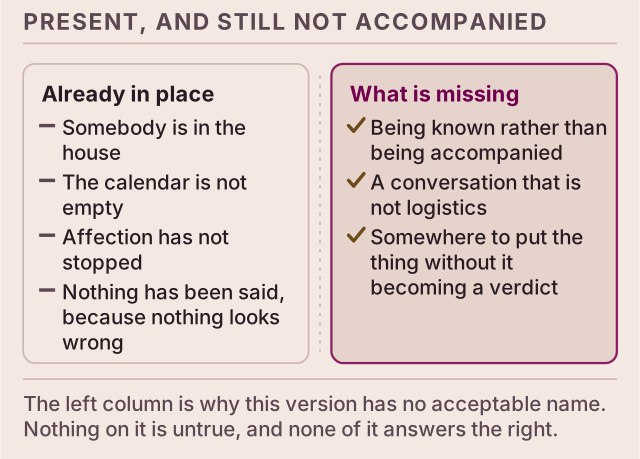
Feeling lonely in a relationship is loneliness with the explanation removed. The usual account of the state involves an empty flat and an empty calendar, and here neither is true: somebody is in the house, the week has things in it, and the arrangement that is supposed to answer loneliness is already in place. The state arrives anyway, and it arrives without a name that anyone would accept.
That missing name carries much of the weight. A person who is by themselves has a sentence available — I have been on my own a lot — and it explains itself. A person sitting next to somebody has no equivalent sentence that does not sound like an accusation, which is why so much of this stays unsaid, including to the one other person who is close enough to hear it.
What is actually missing when nothing is missing?
Presence is somebody being in the room; closeness is somebody having some of you in mind while they are in it. A relationship supplies both at the start without anyone having to arrange either. They come apart quietly, and only one of them is visible from outside.
Consider a week that is entirely functional: the logistics get handled, the meals happen, the calendar is coordinated, nothing is neglected. Every observable measure of a working household is met. What has thinned is the part that has no observable measure — the ordinary, unnecessary talk that is how two people stay informed about each other rather than about the week.
This is the part that makes the state so hard to raise. There is no incident to point at. Nothing has been done to anybody. The complaint, if it were made, would be about an absence of something that was never scheduled in the first place.
Why does this version stay unsaid?
Because saying it costs more than the other versions. A bid is a small, low-stakes attempt at contact — a remark about nothing, a hand on a shoulder, a story that has no point to it. Bids are cheap to make and cheap to miss, and missing one is not an event. A run of them being missed is not an event either, which is how the change happens without a date attached to it.
The other cost is that the sentence has two readings. I have been lonely describes a state. Heard from the other chair, it is an accusation with a person named in it. For instance, the same words can land as an account of an evening or as a verdict on a marriage, and the speaker does not get to choose which one arrives.
Work on couples has described the same territory from the other direction — as a matter of whether people can reach each other and be reached, rather than as a matter of who is at fault. Hold Me Tight (Johnson, 2008) is written around that framing. It is named here as a place the subject is treated seriously, not as an instruction and not as evidence about anybody’s relationship.
Is this the same as not being in love any more?
They are different questions and they get collapsed constantly. Loneliness inside a relationship is about a gap between the contact that exists and the contact that was wanted. Whether a relationship should continue is a decision about a future. The first can be described; the second is not a thing a page can be involved in, and nothing here weighs it up.
The reason they get collapsed is that the state has no other available explanation, so it borrows the nearest one. Imagine the same quiet evening read two ways: as an evening where two tired people did not talk much, and as evidence about a whole marriage. The evening is identical. Only the second reading has a verdict in it, and the verdict is not more accurate for being larger.
Adult attachment research treats close adult relationships as attachments in the same sense as earlier ones — an argument made in Hazan and Shaver’s 1987 paper, which extended attachment theory to romantic relationships. That is a claim about a framework, not a claim about what any particular distance means, and it is quoted here for exactly that much.
What does this section actually cover?
Three things, and it is worth being explicit about the boundaries:
- The shape of the state inside a relationship: what thins, what stays, and what it is like to notice.
- What happens when it gets said out loud, and why the same sentence lands so differently depending on how it is built.
- Distance that is physical rather than emotional, which is a different problem wearing the same word.
What is deliberately not here: verdicts on anybody’s marriage, checklists for reading a partner, and the assumption underneath most writing on the subject — that a relationship is what cures loneliness. On this site it is one of the places loneliness happens.
Where this section stops
It stops before the decision. It also stops before the clinical border: if the state has stopped lifting at all, or has turned into hopelessness, or has moved into sleep, eating and the ability to work, that belongs with a doctor or a therapist. And it stops well short of anything that would count as couples’ advice, which is not what a page describing a state is able to be.