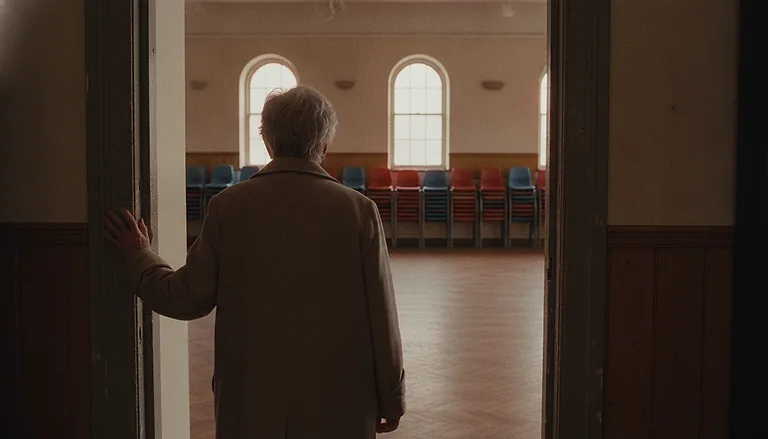
How to make friends in your 50s is a question normally answered with a list of places to go, and the place was never the part that broke. What broke is quieter and structural: the arrangements that used to supply company have ended, and nothing has been put in their place because nothing had to be put there before.
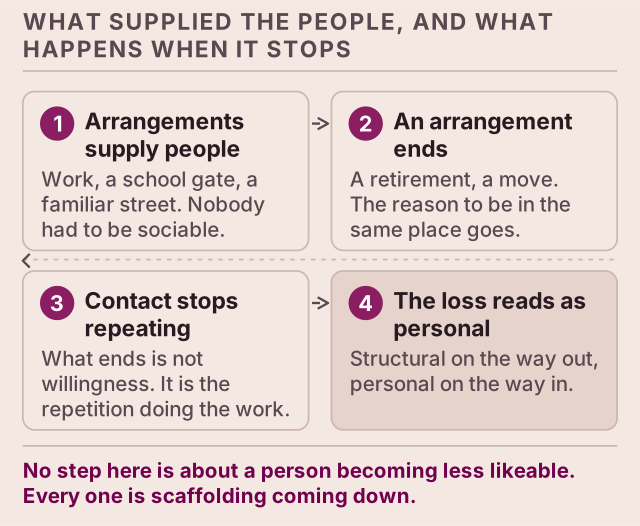
Structural company is contact that arrives as a by-product of something else. Nobody arranges it and nobody experiences it as socialising. A shift rota supplies the same faces without a decision. A school gate supplies a standing appointment with other parents. A street lived in long enough supplies recognition. All of it produces the one ingredient that friendship runs on — repetition — without anybody having to ask for it.
What actually changes after fifty?
The supply stops, and it stops without an announcement. A retirement, a move, a household changing shape, a job that turns remote: each of them removes a source of repeated contact, and the friendships that were sitting on top of that source lose the thing that was holding them in place. Nothing has been ended by anybody. There is nothing to be upset about in particular, which is exactly why it takes so long to notice.
Consider a friendship that was entirely real and entirely dependent on a shared corridor. Neither person did anything. The corridor went. What is left is two people who like each other and now need a reason to arrange something, and arranging is a completely different skill from turning up.
Why does the loss read as personal?
Because the mechanism is invisible and the outcome is not. A thinned circle is what remains when arrangements end and nothing replaced them: the same person, the same capacity for friendship, and a week with nobody in it. Seen from inside, the only visible variable is the person, so the person is what gets blamed.
Three things happen at once here, and separating them is worth doing:
- The structural loss: the arrangement that produced contact has ended.
- The reading of it: an absence with no cause attached gets read as a verdict on how likeable somebody is.
- The second loss: the reading makes the next attempt more expensive than the first one was.
For instance, somebody who has not been asked anywhere for a stretch will read an unanswered message differently from how they would have read it a decade earlier. The message is the same. What has changed is what it is being asked to prove.
Why does the usual advice for this age group land wrong?
Because it names an activity, and the state is made of a person. A venue list is an answer to the question of where, and where was not the question. Being told to join a class arranges a room, an hour and a subject. Whether anyone in that room ends up knowing anything about you is the part that would matter, and it is not on anyone’s schedule.
The other mismatch is about novelty. What people describe as having helped is rarely the new thing — it is the same room, the same evening, the same faces, kept up long enough that arriving stops being a decision. Advice is written around starting, because starting is what can be instructed. Imagine being told to go somewhere once, when the whole mechanism is in going back.
What does this section cover?
The state rather than the activity: what changes after fifty, what changes after sixty, what retirement does to the shape of a week, and why the advice written for this age group addresses a life that is not the one being lived. No venues are named, no organisations are recommended, and nothing here promises what a first attempt will produce.
It is also worth naming what this section deliberately does not do. It does not rank how common any of this is — this site publishes no figures it cannot trace to a named source, and it holds none on this subject. It does not sort readers into types. And it does not offer a plan, because a plan that fails leaves the reader carrying the failure, which is the main reason there is no plan here.
Where this section stops
It stops at the point where a description would have to become a prescription. It also stops at the clinical border: if the state has stopped lifting at all, or has turned into hopelessness, or has moved into sleep, eating and the ability to work, that is a conversation for a doctor or a therapist rather than for a page about a thinned week.