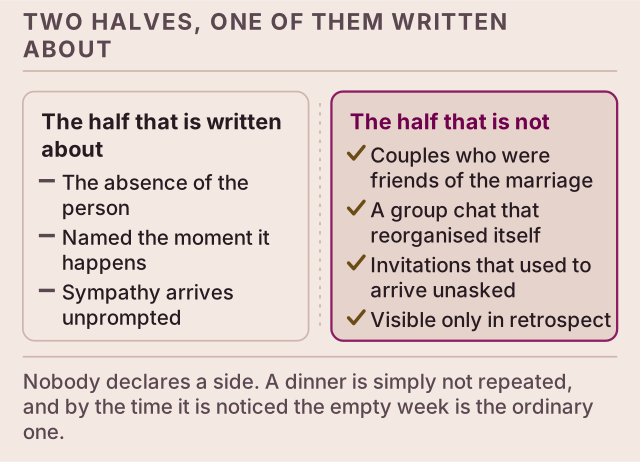
Loneliness after divorce is normally described as the absence of one person, and that account is missing a half. The other half is social: a circle that came apart at the same time, without anybody announcing it and without anybody meaning to. A dinner is not repeated. A friendship turns out to have been somebody else’s all along. Somebody stays in touch with both households, finds it awkward, and stops.
A friend of the marriage is somebody whose connection ran through the household rather than through either person in it. Nothing about that is disloyal or shallow; it is simply how shared circles are built. Two people are invited as a unit, and the unit is what the invitation is addressed to. When the unit stops existing, the address stops working.
Why does the circle divide without anyone choosing sides?
Because most of it never required a choice. The arrangement that produced the contact has ended, and the contact ends with it — the same structural mechanism that operates when a job stops or a street changes, running at speed and under a name that makes it look personal.
Consider a couple who came to dinner four times a year for a decade. There was no falling out and there is no decision to be made. There is a dinner that would now have to be arranged by one person, with one person, for the first time. It is not that anybody refused. It is that nobody initiated, and initiating was never previously required of anyone.
For instance, a group chat rarely announces a change. It thins, then it reorganises, then at some point there is a different chat that nobody mentioned. The absence of an announcement is what makes the whole thing so hard to describe afterwards: nothing happened, repeatedly.
Why does it arrive later than people expect?
Because the practical stage supplies structure, and structure is cover. The practical stage is the stretch where there is a process to run — paperwork, logistics, a house, an argument to be had on a schedule. It is exhausting and it is full. A full week does not feel like an empty one, whatever else is wrong with it.
The state becomes visible when the process ends and the week has nothing in it. Imagine the first Saturday with no handover, no appointment and no dispute to prepare for. Nothing has got worse on that day. What has gone is the last thing that was standing between the person and the shape of the week.
Is this the same as missing the marriage?
They are different absences and they are worth keeping apart, because they close differently. Missing a person is about one particular closeness that general company does not replace. A thinned circle is about a week with nobody in it, and that one does answer to people in general. Read as a single feeling, they produce the conclusion that nothing helps — when in fact each half would answer to something different.
This site prints no figures on any of it. Anyone who wants the demographic picture of divorce should read it from the people who actually collect it: the U.S. Census Bureau publishes Number, Timing, and Duration of Marriages and Divorces (Census Bureau, 2021). It is linked here as the place the numbers live, not as support for anything on this page — nothing above is a claim about how common any of it is.
What is involved in rebuilding an ordinary week?
Less than the phrase suggests and more work than it sounds. Three things are worth separating:
- What went with the household, and was never independently yours to keep.
- What survived and now needs a second connection built on purpose, because the first one ran through an address that no longer exists.
- What is simply new, and starts at the beginning like anything new does.
None of those is a plan, and this section does not supply one. What it can describe is that the second category is the one people underestimate: a friendship that was entirely real can still need to be started again from a standing position, and that is not a sign that it was never real.
Where this section stops
It stops at the ex. Nothing here concerns the former spouse, the process of divorcing, or meeting somebody new — those are separate subjects with separate questions attached, and mixing them in is how a page about friendship turns into a page about a marriage.
It also stops at the clinical border. If the state has stopped lifting at all, if it has turned into hopelessness, or if it has moved into sleep, eating and the ability to work, that is a conversation for a doctor or a therapist rather than for a website describing a Saturday.