Learning to be alone is what people mean when the living-alone part is already settled and the rest of it is not: the lease is signed, the routine works on paper, and the evenings are still long. It is a question about the hours, not about the address. This page describes the state and the mechanics under it, not a plan for wanting it.
Why is being alone so hard at first?
Being alone is a fact about who else is in the flat, and it is hard at first because those other people were holding a structure nobody noticed them holding. Their footsteps set the pace of an evening, their questions started conversations, and their presence marked the difference between “the day is still going” and “the day is over.” Remove them and the hours arrive without shape, all at once.
That is why the difficulty does not land where it is expected. It is not the big empty spaces — a free Saturday can be fine. It is the small transitions, such as walking into a flat where nothing has moved since morning, the stretch after the plates are cleared, or the moment the last thing on the list is done and the evening is still there.
Living alone and feeling lonely are not the same problem stacked twice. One is a fact about the address; the other is a shortfall of contact that would exist in a full house too. The difference between being lonely and being alone matters here, because early on the two blur into one feeling.
How do you cope with living alone?
Coping with living alone is mostly a construction problem rather than an emotional one. Whatever the household used to produce without anyone arranging it — a schedule, background sound, a reason to be dressed by a certain hour, a person who expected you back — now has to be put in place deliberately. That is the whole task, and it is unglamorous.
A shape to the day. Not a productivity system. Fixed points: a time the day starts, one thing that happens outside the flat, a time the evening turns into something else. Fixed points give the hours edges, and hours with edges are easier to be in than an undifferentiated block.
Contact that is scheduled, not hoped for. Waiting to be contacted turns a phone into a scoreboard. Consider a standing arrangement instead — a weekly call, a regular class, the same shop on the same morning. It removes the daily verdict about whether anyone thought of you.
Sound, used honestly. Radio and podcasts work because they imitate the background presence of other people, and that background is exactly what left. That is not self-deception; it is replacing a specific missing input. It stops working when it runs all day to keep any thought from surfacing.
Leaving the house as an event, not a chore. The errand is not the point. Being in a place where other people are, on a repeating basis, does something the same errand done online does not do.
None of this is about meeting anyone. Making friends is a different task with its own mechanics; what is described here is the state itself and how to make the week hold.
How can I come to terms with being alone?
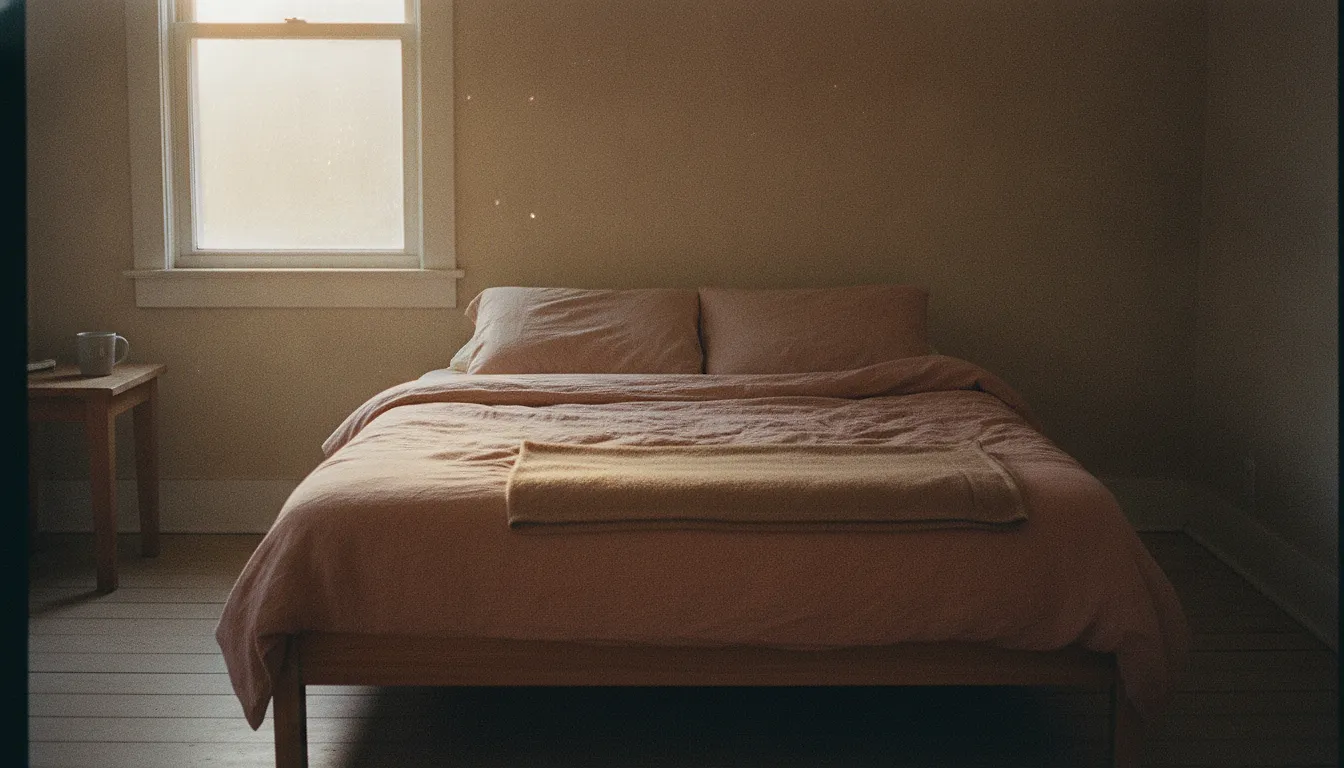
Coming to terms with being alone happens by changing the terms, not by talking yourself into liking them. The shift is practical: the flat stops being a place where you wait for life to resume and becomes a place where some hours are actually spent on something. Acceptance, when it comes, follows that change rather than causing it.
There is a version of advice on this that asks people to reframe the situation as a gift. That request is worth refusing. Chosen time alone is time by yourself that can be ended at will, and it is a different state from time alone that was handed to you — the page on loneliness versus solitude sets out where the two separate. Pretending the second is the first mostly adds a layer of guilt to whatever was already there.
What does move is the amount of the week the state occupies. Early on it can take everything outside working hours. Later it can narrow to particular hours — the arrival home, Sunday afternoon, the stretch after dark. Narrowing is not the same as resolving, and it is what changes.
How do you live a full life alone?
A full life alone is one where the things a shared household supplies by accident are supplied on purpose. Someone who expects to see you again. A reason to be somewhere at a set time. A meal that is prepared rather than assembled standing up. Each of these is small; the absence of all of them at once is what makes a flat feel like storage.
The word “full” causes trouble here, because it suggests a life that photographs well. The working version is duller: a week with recognisable parts, a couple of fixed obligations to other people, and something in progress that is not work. Not enrichment. Structure.
Two habits do quiet damage. The first is treating the current arrangement as temporary indefinitely — nothing gets built, because building would admit this is the situation. The second is filling every empty hour with screens, which prevents the hour from being empty without making it into anything.
Nights deserve their own note. The state gets sharper after dark for reasons that have nothing to do with progress or the lack of it, and reading it as deterioration is a mistake — why loneliness gets loud at night covers what is actually happening in those hours.
What if it is not getting easier?
Sometimes it does not get easier, and that is not a sign of insufficient effort. The idea that a state improves in proportion to how well someone handles it is comfortable and not true. Some people keep every arrangement in place and still find the evenings hard.
What changes instead is coverage: how much of the week is held by something else. The state stays roughly the same size and takes up less territory. That is a smaller claim than “it gets better,” and it is the one that holds up.
There is also a version of settling that is not settling. Adult attachment research describes two broad directions people move in when the closeness they want is not available — pressing harder for it, or shutting the need down (Mikulincer and Shaver, 2012). The second one is quiet from outside. Imagine somebody who has stopped answering invitations and describes themselves as having become a private person: the description may be exactly right, and it may be the need switched off. Nothing on this page can tell those two apart, and it does not try.
There is also a threshold worth naming plainly. If the hard part has stopped having a schedule — if it is not the evenings or Sundays but all of it, for months, and the ordinary machinery of eating, sleeping and getting out of the door has gone with it — that is past what a page about a state can address. It is a reason to talk to someone, not a reason to try harder.
What this page will not tell you to do
This page describes a state. Some things sit outside it on purpose.
- Tell you to enjoy it
- Time alone that was not chosen is not solitude with a better attitude. Framing it as a gift adds guilt on top of the original problem.
- Hand you a hobby as the answer
- A dog, a class, a language app — any of these can help, and none of them is a solution to a shortfall of contact. Advice that stops at the list is advice that skipped the state.
- Point you toward a partner
- Loneliness is not treated by a relationship here. It happens inside relationships too, which is a separate page and a separate mechanism.
- Print numbers
- No percentages, no timelines, no claims about how long this lasts on average. Nothing on this site has a figure behind it that traced back to a source we opened, so there are no figures. Where a paper is named on this page, it is named for an idea and never for a number.
- Decide what is happening to you
- This page cannot tell the difference between loneliness and something that needs clinical attention, and it does not attempt to.
Where this page stops
This page describes a state and the arrangements people build around it. It cannot tell whether what someone is living through is loneliness or something else — loneliness and depression are different things, and nothing written here distinguishes one from the other. If the difficulty is constant rather than tied to particular hours, or if the basic machinery of the day has stopped working, the next step is a conversation with a general practitioner or a therapist, or a helpline in your country.