
How do you cope with loneliness?
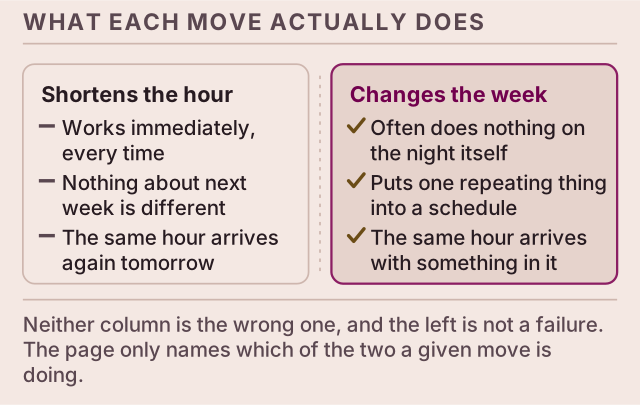
Coping with loneliness means working on the conditions around the state rather than on the state directly. Nobody talks themselves out of it, and nobody decides to stop feeling it. What can be changed is the shape of a week: where contact is scheduled rather than hoped for, which hours have something in them, and whether there is any fixture that repeats regardless of mood.
That is a smaller claim than much of what is written about this subject, and it is the honest one. The state responds to arrangement over time. It does not respond to being addressed head-on at the moment it peaks.
One consequence: an evening spent trying to feel less lonely goes badly, because the feeling is the thing being attended to. Another: the work happens on ordinary days, when nothing is particularly wrong, and the payoff shows up on the bad ones.
What a page like this can do is describe the mechanics: what the advice everyone has already heard is actually pointing at, what people are describing when they say something helped, and why the same thing does not transfer intact into another life.
Why does advice like “get out more” not work as an instruction?
Because it names an outcome and presents it as a step. “Get out more”, “put yourself out there”, “learn to love your own company” — each of those is a description of someone who is already on the other side of the problem. Told to a person who is not, they contain no action.
An instruction is something that says what to do first, and most of this advice does not. Going out is downstream of knowing a place to go, having a reason to be there that survives arriving alone, and having the energy that leaving costs on a flat day. Skip those and the sentence describes a destination while pretending to be a map.
The same applies to the internal versions. “Love yourself” is not something a person can perform on demand. “Change your mindset” asks for the result of a process and calls it the process. Advice in this shape has one predictable effect: the reader concludes the failure is theirs, since the step sounded easy and did not happen.
There is a reason so much writing in this subject takes that form. Exhortation is cheap to produce, sounds warm, and cannot be falsified. Mechanics are specific enough to be wrong, which makes them riskier to write and more useful to read.
What that means practically: when a piece of advice cannot be turned into something enterable in a calendar, it is not advice. It is encouragement wearing advice’s clothes, and it is fine to put it down.
What do people describe when they say something helped?
When someone says a choir, a dog, a night shift or a Tuesday class helped, the activity is not the part doing the work. Structure is what the account is actually describing: a time that recurs, a place where arriving is unremarkable, and other people who register that you were there.
The dog is a reason to be outdoors at the same hour daily and to exchange words with the same faces. The choir is a fixed slot with a task in it, where nobody has to make conversation to justify their presence. The volunteering shift supplies a role, which is easier to occupy than a personality.
The ingredients that keep showing up in those accounts have little to do with the activity:
- Repetition. Something that happens again without needing to be re-decided each time. A single good evening does not do it; the same modest thing recurring does.
- A reason for being there that is not “meeting people”. A task, a job, an animal, a purpose. It removes the pressure that makes a room unbearable.
- Being recognised. Not friendship. Being the person the barman, the neighbour or the group nods at. That kind of low-grade recognition does something that intense one-off contact does not.
None of that is inspiring, which is exactly why it is left out of the advice. It also explains the odd flatness in how people describe what worked: they are describing plumbing, not a revelation.
The other side of what people describe is subtraction. Fewer evenings where the plan was to hope someone texts. Less scrolling through other people’s assembled lives at the hour when the state is already loud. The removals are as much a part of the account as the additions.
Why does what worked for someone else not transfer to another life?
Because what gets copied is the visible container and not the arrangement inside it. Consider somebody’s swimming club: it ran on their shift pattern, their bus route, their body, their tolerance for changing rooms, and a room where they were already half-known from being long settled in the same town. Move the swimming and leave those behind, and the working parts stayed where they were.
This is why recommendation lists are a weak genre for this. The list names activities. The mechanism was never the activity — it was the fit between a fixture and a particular life’s constraints, and those constraints are not visible from outside.
It is also why the failure of a copied solution gets read as a personal verdict. A person tries the thing that worked for someone else, feels nothing, and concludes there is something wrong with them specifically. The more accurate reading is that a container was transplanted without its contents.
The usable version is to run the copy in reverse. Instead of asking what someone did, ask what their arrangement supplied: which hour it occupied, what excused their presence, who noticed them. Then look for something in reach that supplies the same, however unlike the original it looks. A hardware shop errand at the same time each week is not a choir, and it can hold a similar function.
Loneliness also comes in kinds that answer to different things — the absence of one close attachment is not the absence of a group, and a fixture that fills one leaves the other untouched. That distinction is set out in kinds of loneliness, and it accounts for a lot of advice that seemed sensible and did nothing.
What to do when feeling lonely right now?
In the moment, aim for a shorter stretch rather than a resolved one. The state at its peak is not the moment for arrangements, decisions, or conclusions about a life. It is the moment for changing the physical conditions and letting the rest wait.
Changing conditions means the room, the light, the sound, the body — for example a different chair, or a lamp instead of a screen. A voice on the radio, which is not company but occupies the channel that would otherwise run commentary. An errand that puts a person outdoors among strangers, which does more than it sounds like it should.
Contact is worth attempting and is not obligatory. A message sent into a silence that stays silent leaves the evening worse than it was, so a low-stakes version — a note written now and sent in daylight, a reply to something old, a call to whoever is easiest — costs less if it goes nowhere.
What makes it worse is easy enough to name: scrolling other people’s evenings, drinking on it, rehearsing the case for why nobody is in touch, or making a decision about a job or a relationship at the hour when the verdict feels most certain and is least checkable. The hour has a bias, and the bias is not information.
The night version of all this has its own mechanics, described in lonely at night. The broader pattern — that the state arrives on a schedule rather than at random — sits on the when it hits hub.
How do you deal with loneliness that has no event behind it?
Loneliness without a triggering event needs no explanation to be legitimate. Nothing has to have happened. A circle can thin through moves and schedules and nobody’s decision, and the resulting gap is the same gap that a divorce or a bereavement produces more visibly.
The trouble the no-event version causes is interpretive. With no cause to point at, the mind supplies one, and the cause it supplies is a defect in the person. That step is where a manageable state turns into a judgement, and the judgement is what makes the state harder to act on.
There is a second thing worth naming, because it is easy to mistake for a preference. Adult attachment research describes two broad directions people move in when the closeness they want is not available — pressing harder for it, or shutting the need down (Mikulincer and Shaver, 2012). That is a description of strategies rather than a diagnosis of anybody, and it is quoted here only that far: the paper is not about loneliness specifically. What it is useful for is the reminder that the version which looks like having stopped minding is a direction of travel rather than necessarily a settled position.
Removing the search for the cause is not denial. It is redirection: the useful question is not why this is happening to someone who has done nothing wrong, but which specific contact is missing — a close one, a group, or the ordinary background of being known in a place. Each of those has a different answer, and none of them are answered by self-assessment.

How do you manage loneliness over a long stretch?
Managing loneliness means maintenance rather than cure. Over a long stretch, what people describe is upkeep: keeping the fixtures during the periods when they feel pointless, because those periods are what the hard ones draw on, and treating the state’s return as weather rather than as evidence that the whole arrangement failed.
The mistake that undoes long-term progress is dismantling the structure once it seems unnecessary. The class gets dropped during a good month. The standing call slides. Nothing is felt at the time, because the good month is doing the covering, and the absence registers later when it is harder to rebuild than it was to keep.
There is also a version of this that involves living alone as the ongoing condition rather than the temporary one, where the work is less about contact and more about what an empty flat is for. That is a different set of mechanics, set out in learning to be alone.
And there is an honest limit to state plainly: this does not resolve for everyone, and a page cannot say who it will resolve for. Continuing to keep the arrangement while the state persists is not failure. It is the actual shape of the thing for some people, and calling it failure adds a second problem to the first.
What this page does not do
This subject attracts confident writing. Here is what is deliberately absent from it.
- No numbered list of tips
- No ranked steps, no method with a name. A list implies an order that works across lives, and the whole argument of this page is that the order is local to a person's constraints.
- No promise of relief
- Nothing here says a reader will feel better by a certain point, or at all. Any page that promises an outcome for a state it cannot see is selling something, even when it is free.
- No numbers
- No percentages, no counts, no borrowed authority. Nothing on this site quantifies loneliness, because no figure has cleared the source check — and an unsourced number in a subject like this is folklore with a decimal point.
- No diagnosis
- This page describes a state and what people do with it. It does not assess a reader's mental health, list symptoms, or decide what is behind the feeling.
- No services named
- No apps, no groups, no platforms, no organisations. Recommending a service in a subject this sensitive would require checks this page has not carried out.
Where this page stops
This page describes coping as mechanics, and it cannot see the person reading it. It cannot tell whether what is being experienced is loneliness, low mood, exhaustion, or something else: loneliness and depression are different things, and nothing here distinguishes between them. Anyone whose state is not shifting, or whose sleep, appetite or ability to work has changed, or who is having thoughts that go past feeling alone, is better served by a conversation with a general practitioner or a therapist, or by contacting a helpline in their country.