
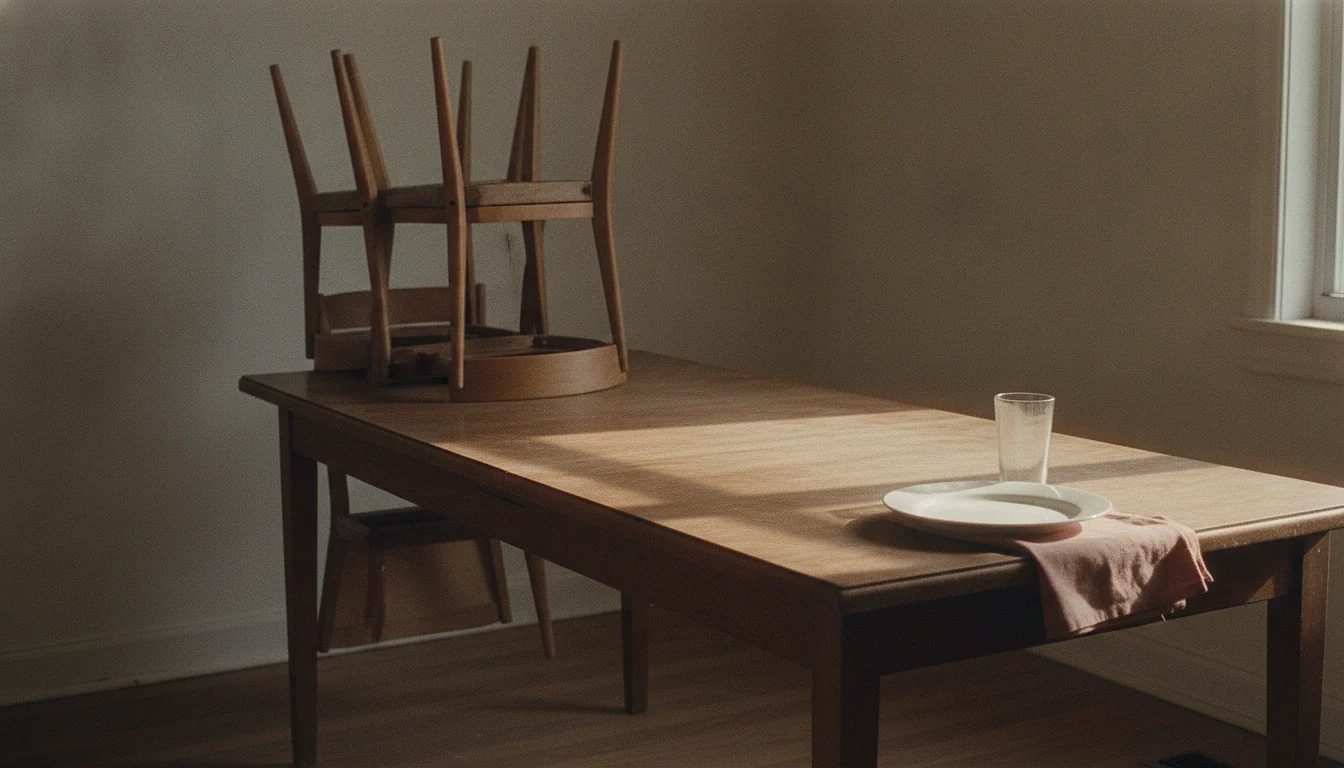
Friends after divorce is a question about the second loss, not about the ex-partner. People asking it are not asking about the marriage at all. They are asking why the phone stopped, why the Saturday plans evaporated, and why a life that had people in it last year now has a diary with nothing personal on it. This page is about that second loss: the circle that ended along with the marriage.
What happened to the friends when the marriage ended?
Because a large part of the circle was attached to the household rather than to either person. A friend of the marriage is somebody whose connection ran through the household — for example couple friendships, in-law contact, the other parents from school, or the standing invitations that arrived addressed to two names. When the marriage ended, the arrangement that carried them ended too.
That is a structural fact, not a verdict on anyone’s character. Nothing has been discovered about the person who is now alone on a Saturday. What has been discovered is how the contact was held: by an arrangement, and the arrangement is gone.
It is worth being precise about the difference, because the two explanations lead to completely different weeks. If the friends left because of who someone is, the task looks like self-repair. If they left because the structure that produced them dissolved, the task is building a different structure. Only the second one is a task that can be done.
Whose friends were they, actually?
One partner’s first, with the other joining by attendance. That imbalance is invisible while the household is intact, because everyone arrives at the same table anyway. It becomes obvious afterwards, when the invitations quietly keep following the person who made the introductions in the first place.
This is an unpleasant question and there is no dignified way to soften it. Someone who spent years as the one who came along may find that almost the entire adult social life was borrowed. The friendliness was real. The connection was routed through someone else.
The other pattern is subtler: friendships that both people genuinely made, which nonetheless existed in a couple format, such as dinners for four or holidays with two families. Those do not survive being halved, because the format was the friendship, and there is no version of the format with one person in it.
None of this is worth relitigating. Working out whose friends they were is only useful for one thing — knowing that the diary is empty for a reason that can be addressed, rather than for a reason that lives inside the reader.
Is it normal to lose everyone?
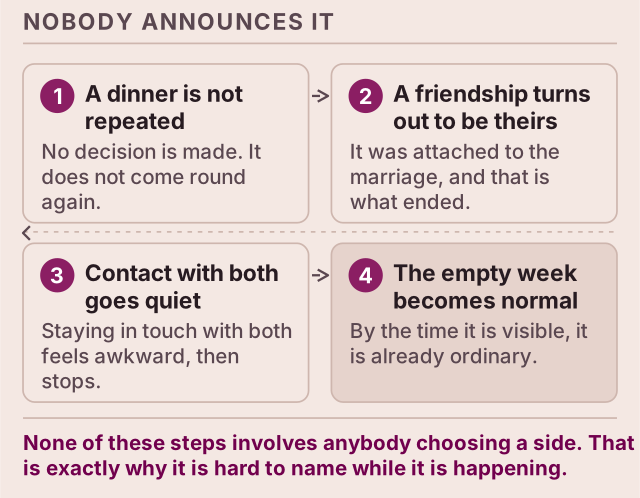
A shared circle comes apart without a single announced decision. Drift is contact thinning with nobody deciding anything: invitations simply get easier to send to the household that still looks like a household, and nobody says they are choosing sides.
This site prints no figures on any of it. Anyone who wants the demographic picture should read it from the people who collect it — the U.S. Census Bureau publishes Number, Timing, and Duration of Marriages and Divorces (Census Bureau, 2021). It is linked as the place the numbers live, not as support for anything on this page: nothing here is a claim about how common any of this is.
That it happens by drift does not make it painless, and this page will not use the word normal as a sedative. Watching a shared world quietly reorganise itself without you is its own specific injury, separate from the end of the marriage, and it arrives later — after the legal part is finished and everyone has stopped checking in.
Some of the disappearance is not about sides at all. Divorce makes people awkward. Friends who do not know what to say sometimes say nothing, and the silence gets interpreted as a judgement it may not be. That does not make the absence less real, but it changes what it means, and it means less than it feels like it means at two in the morning.
The hub page on loneliness after divorce covers the wider shape of that first year, including the part where the ordinary hours are harder than the dramatic ones.
What does rebuilding actually look like?
Repetition rather than intensity. One or two fixed points in the week where the same faces appear, attended regardless of mood, kept up long enough that being recognised happens before anything has to be arranged. That is the entire method, and its dullness is the reason it does not get written down.
The instinct after a divorce is the opposite: make something happen, quickly, and at scale. A big night out, a burst of messages to people not spoken to in years, an intense new friendship formed at speed. Those produce activity and not much contact, because contact is a function of being around the same people repeatedly, not of effort spent in one go.
A fixture is anything that repeats without needing a fresh decision each time, such as a class with an attendance list, a volunteer shift with a rota, a weekly training session, a regular counter at a regular hour, or a standing call on a set day. What makes it work is not the activity but the fact that skipping it takes more energy than attending.
Two things make this stage harder after a divorce specifically. The first is that it has to be done while depleted, at exactly the point when nothing feels worth the effort. The second is that the effort itself feels humiliating for anyone who had a full social life not long ago, because it exposes how much of that life was arranged by circumstances rather than built. Neither of those is a reason it will not work. Both are reasons it feels worse than it looks on paper.
The sequence, when it does work, is unremarkable: attendance, then familiarity, then someone noticing when you are not there. The attempt gets judged during the first stage, when the room is still full of strangers, and the conclusion is that it failed. The same room, later on, is full of people who know your name, and nothing changed except that the attending continued.
For anyone whose evenings are going to be solitary for a while regardless, learning to be alone deals with that state directly rather than treating it as a waiting room. If the divorce happened later in life, the way a circle thins after fifty describes the same subtraction arriving without a divorce to explain it.
What about mutual friends who stayed in touch with both of you?
Leave them alone and let them be their own friendships. Consider somebody who genuinely liked both people and is not interested in a narrative: that contact can survive a divorce on its own terms. That survival is fragile in one specific way: it does not tolerate being recruited.
Asking a mutual friend to choose, to explain what the other one said, or to carry a message turns a friendship into a role. That role gets declined by withdrawal rather than out loud. The friendships that last through a divorce are the ones where the divorce is not the subject.
There is no technique here for keeping people, and this page is not going to invent one. What can be said is that mutual friends are not spoils, and that treating them as separate relationships — with their own conversations, unrelated to the marriage that introduced everyone — is what decides whether they are still there later.
Does an empty circle mean starting from zero?
No, though it feels that way, because the count people run in their head is a count of close friends. Contact that falls short of friendship still carries weight: colleagues, neighbours, the people at a regular fixture, family who are in touch. Discounting all of it because none of it qualifies makes the week look emptier than it is.
That is not a consolation prize and it is not offered as one. The absence of one close person is a real shortfall and it is not closed by acquaintances. But acquaintance is the ground that friendship grows from, and it is the part that can be deliberately arranged, which makes it the part worth starting with.
What this page does not do
This page describes what happens to a social circle after a divorce. Several nearby subjects are deliberately left out, and the omissions are not accidental.
- We do not discuss the ex-partner
- No assessment of who behaved how, and no advice about staying friends with a former spouse. That is a different question with a different intent, and this page is about the circle, not the marriage.
- We do not cover the divorce itself
- Nothing here about legal steps, custody, money or the process. Those belong with a solicitor and with people who work on that specifically.
- We do not treat a new relationship as the answer
- Loneliness is not resolved on this site by finding a partner, and rebuilding a circle is not a preamble to dating.
- We do not publish numbers or name places
- No figures about how many friends people lose, how long any of this takes, and no lists of apps, clubs or groups. Nothing here has a verified source behind it, so nothing is stated as one.
Where this page stops
This page can describe how a shared circle comes apart after a divorce and what rebuilding contact for one person involves. It cannot tell what any particular reader is experiencing. Loneliness and depression are not the same thing, and nothing here distinguishes between them or is meant to. Anyone for whom this has been heavy for a long stretch, or is getting heavier, is better served by a conversation with a general practitioner or a therapist, or by contacting a helpline in their country.